


Beyond the Dragon: Why India’s Pax Silica Leap is the AI Game-Changer
Discover why India joining the US-led Pax Silica alliance is a historic move for semiconductor manufacturing, AI infrastructure, and rare earth security.
 Rajeev

In the 20th century, global power was measured in barrels of oil and tons of steel. In 2026, the currency of sovereignty has shifted to silicon and rare earth elements.
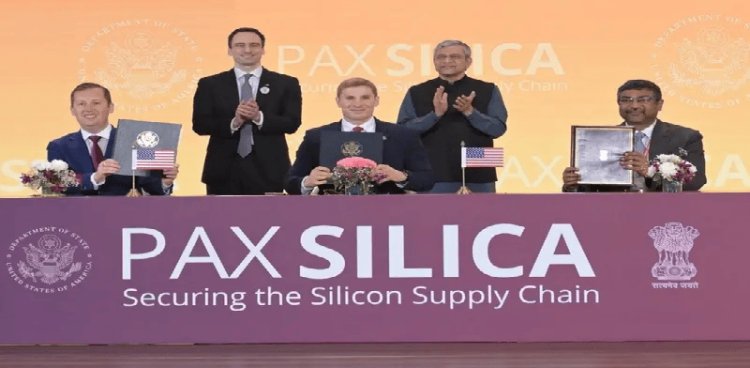
On February 20, 2026, at the Bharat Mandapam in New Delhi, India officially signed the Pax Silica Declaration. This isn't just another diplomatic photo-op; it is a strategic pivot that places India at the heart of the "Silicon Curtain"—a new US-led economic order designed to secure the global technology stack from the mines to the microchips.
What is Pax Silica?
Derived from the Latin "Pax" (Peace) and "Silica" (Silicon), the alliance is a coalition of "trusted" nations including the US, Japan, Australia, South Korea, and now India. Its mission is simple but profound: to build a resilient supply chain for Artificial Intelligence and semiconductors that does not rely on any single, non-aligned nation.
While the official language speaks of "collaboration," the subtext is clear—it is about breaking China’s 90% stranglehold on rare earth processing and ensuring that the "commanding heights" of technology remain in the hands of democratic allies.
Why India’s Entry is a "Big Deal"
India’s inclusion as the tenth full member of Pax Silica is a win-win for the global tech ecosystem. Here is why this alliance is a massive milestone:
1. The Rare Earth Equation
India sits on approximately 8.52 million tonnes of rare earth reserves—one of the largest deposits in the world. However, until now, the lack of processing technology meant India remained dependent on China for the magnets used in everything from EV motors to defense systems. By joining Pax Silica, India gains access to advanced processing know-how from partners like Australia and the US, turning its "sleeping" reserves into a global strategic asset.
2. From Chip Design to Fabrication
India is already a global powerhouse in chip design, with its engineers recently "taping out" cutting-edge 2-nanometer chip designs. What has been missing is fabrication (fabs). Through Pax Silica, India is expected to see a surge in FDI from giants like Micron and ASML. With ten semiconductor plants already in various stages of development, this alliance provides the "trusted partner" status required for the world’s most sensitive lithography technology to land on Indian soil.
3. Powering the AI Economy
AI doesn’t live in the "cloud"—it lives in massive data centers powered by high-end GPUs. Pax Silica ensures that India isn't just a consumer of AI, but a builder. The alliance focuses on the entire "silicon stack," including fiber-optic networks and frontier AI models. As US Ambassador Sergio Gor put it, the goal is to ensure innovation happens in "Bangalore and Silicon Valley," rather than in surveillance-heavy states.
The "China-Plus-One" Strategy 2.0
For years, the world talked about "China Plus One." Pax Silica is the operational version of that talk. By pooling Australia’s mineral wealth, the Netherlands’ manufacturing equipment, and India’s engineering depth (a talent pool of over 1 million professionals), the alliance creates a closed-loop ecosystem that is immune to "supply chain weaponization."
What This Means for the Future
For the average viewer, this means India is no longer just the world’s back office; it is becoming the world’s high-tech foundry.
-
Jobs: The semiconductor mission is expected to create over a million high-skilled jobs in India.
-
Prices: Secure supply chains mean more stable prices for electronics and EVs.
-
Security: Enhanced domestic manufacturing ensures that India's defense and telecom infrastructure are built on "trusted" hardware.
Final Thoughts
The signing of the Pax Silica declaration marks the end of India’s era of strategic ambiguity in technology. By choosing to co-found this new "Silicon Peace," India has signaled that it is ready to take global leadership.
As Union Minister Ashwini Vaishnaw noted, the spirit of "compounding growth" is now in full swing. India isn’t just joining an alliance; it is help-writing the rules of the 21st-century economy.
Disclaimer: This article is an original analysis based on recent geopolitical developments and is intended for informational purposes.