


The Sky is Burning: Is the US Unleashing ‘Air Armageddon’ on Iran?
Discover the chilling details of the potential "Air Armageddon" in West Asia. As three nuclear-capable giants dominate the skies, we analyse the strategic shifts and the catastrophic risks of a full-scale US-Iran confrontation.
 Rajeev
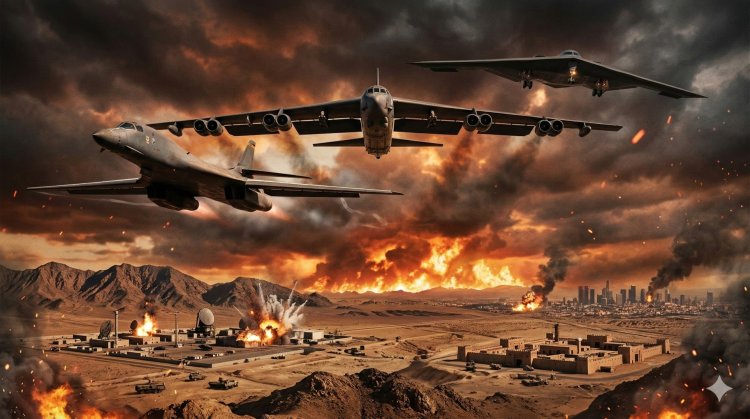

The horizon over West Asia is no longer just a backdrop for geopolitical posturing; it has become a canvas of imminent catastrophe. In recent weeks, the deployment of three "nuclear giants"—the backbone of the United States’ long-range strike capability—has signalled a shift from traditional deterrence to what many military analysts are calling the "Air Armageddon" phase. As tensions between Washington and Tehran reach a fever pitch, the world watches with bated breath: Is this a final warning, or the opening act of a continental disaster?
The Three Nuclear Giants: A Show of Overwhelming Force
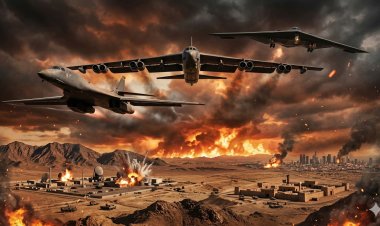
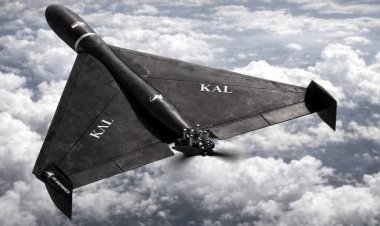
The centrepiece of this escalation is the presence of the U.S. military’s most formidable aerial assets: the B-52 Stratofortress, the B-1B Lancer, and the B-2 Spirit. These are not merely planes; they are symbols of "Global Strike" capability.
-
The B-52 Stratofortress: A Cold War relic turned modern juggernaut, capable of carrying a massive payload of conventional and nuclear cruise missiles.
Its presence in the region acts as a flying fortress, visible on radar as a deliberate psychological "hammer." -
The B-1B Lancer: Focused on high-speed, low-level supersonic flight, the Lancer provides the "rapid response" element, capable of penetrating sophisticated air defences.
-
The B-2 Spirit: The ultimate "ghost." This stealth bomber can strike the most hardened Iranian nuclear facilities without ever being detected, making it the most feared asset in the American arsenal.
When these three giants operate in tandem over the Persian Gulf, the message is clear: the U.S. is prepared for a "decapitation strike" against Iranian infrastructure.
The "Trump Plan" and the Return of Maximum Pressure
Central to the current volatility is the looming shadow of the "Trump-era" Middle East doctrine. This policy, characterized by "Maximum Pressure," seeks to bankrupt the Iranian regime through sanctions while maintaining a credible, heavy-handed military threat.
The strategy is built on the belief that Tehran only retreats when faced with the prospect of total annihilation. However, critics argue this plan is a recipe for catastrophe. Unlike previous decades, Iran now possesses a "Ring of Fire"—a network of proxies in Lebanon, Iraq, Syria, and Yemen—capable of retaliating against U.S. bases and global oil chokepoints like the Strait of Hormuz.
Why West Asia Faces a Catastrophe
The term "Air Armageddon" isn't hyperbole. A full-scale aerial campaign against Iran would differ significantly from the wars in Iraq or Afghanistan.
-
Regional Contagion: Any strike on Iranian soil would likely trigger a massive missile barrage from Hezbollah into Israel and Houthi attacks on Red Sea shipping, effectively shutting down 12% of global trade.
-
The Nuclear Question: While the U.S. bombers are "nuclear-capable," the real danger lies in the conventional destruction of Iran's nuclear sites. Such an act could lead to environmental disasters or, conversely, push Iran to finally cross the threshold and assemble a functional nuclear warhead in self-defence.
-
Economic Meltdown: An "Air Armageddon" would send oil prices soaring past $150 a barrel, potentially triggering a global recession that would hit the West as hard as the East.
The Human Cost and the Silent Skies
Behind the technical specifications of bombers and the rhetoric of "surgical strikes" lies a terrifying human reality. West Asia is home to millions of civilians who have already endured decades of instability. A campaign of this magnitude would lead to a displacement crisis that would dwarf the 2015 Syrian refugee surge, destabilizing Europe and neighbouring Arab nations.
Authentic Perspective: Is Diplomacy Dead?
For viewers seeking the truth amidst the propaganda, the reality is nuanced. While the U.S. maneuvers its nuclear giants to project strength, the backchannels of diplomacy are becoming increasingly narrow. The "Trump Plan" assumes that the threat of force will bring Iran to the negotiating table. But in the proud corridors of Tehran, such threats often harden resolve rather than softening it.
A World on the Edge
The sight of B-52s and stealth bombers over West Asia is a grim reminder that peace is fragile. Whether this "Air Armageddon" remains a terrifying exercise in brinkmanship or transitions into a hot war will define the 21st century. One thing is certain: if these three nuclear giants are unleashed, the map of the Middle East—and the security of the entire world—will be rewritten in fire.